
A rezoning notice that was allegedly placed in the wrong location led to a lawsuit against a $2 billion data center project being developed by Eagle Rock Partners in Twiggs County, Georgia. The local community has mounted strong opposition to county officials who approved the data center project in September 2025, challenging the decision and citing lapses in process- from not undergoing a review they say should have been mandatory, to questions around transparency as emails revealed private meetings between Eagle Rock Partners and county commissioners. The state of Georgia has an Open Meetings Act that requires county business to be conducted in public when a quorum of commissioners is present. Other projects across the state are facing regulatory and legal questions that affect timelines, and in some cases could determine viability.
Why Georgia Matters
Georgia has quickly become one of the most attractive data center markets in the country, but it is also becoming one of the most operationally complex. The old playbook of securing land, power, and incentives is no longer enough. Developers now face a fragmented and fast-changing regulatory landscape defined by ordinances that change county by county in the absence of a statewide framework. Moratoriums, Development of Regional Impact (DRI) scrutiny, water concerns, litigation risk, growing public opposition, and ad hoc restrictions vary wildly in scope and rigor, while state legislation is starting to take shape. Key projects, like the one in Twiggs County, have faced legal challenges because of failure to comply with changing regulations and ordinances.
Georgia's rapid emergence as a top-tier data center market is driven by a convergence of factors that collectively make it, at least on paper, one of the most attractive development environments in the country. Newton County's Industrial Development Authority, for instance, has reported a surge in developer inquiries.
- Power prices: As some other markets saturate, developers are drawn by access to Georgia Power's regulated utility model, which provides more predictable power pricing than deregulated markets.
- Land: The I-20 corridor east of Atlanta offers large contiguous parcels at prices far below Northern Virginia or Dallas-Fort Worth.
- Connectivity: The Atlanta metro has emerged as a major fiber and network interconnection hub, anchored by 56 Marietta, the primary interconnection building in Atlanta.
- Incentives: Georgia offers a 100% sales and use tax exemption on certain equipment purchases.
- Big tech investments: Meta's Stanton Springs campus, a 1000-acre site with eight buildings each roughly the length of four football fields, has proven the market's viability and attracted a wave of follow-on interest. Amazon has already started construction on an adjacent campus after purchasing $25 million worth of acreage.
Other states are closely tracking these developments, with local groups in states like Indiana often citing Georgia's legislative activity and ordinances. Georgia could become the template for data center development elsewhere.
For developers, the core risk is not that Georgia is closing to data centers, but that rules are being written right now, county by county, with no centralized tracking and significant variance in outcomes. At the same time, for communities and lawmakers, the challenge is attracting economic opportunity and tax revenues while not socializing the cost of massive infrastructure projects through higher power bills or straining essentials like clean water supply. Regulations and projects that navigate this well will secure approvals and long-term benefits. Projects that ignore it will face moratoriums, lawsuits, and community opposition that can delay timelines by 12–24 months or kill projects entirely.
The hidden shift: the bottleneck is moving from infrastructure to approvals
The biggest risk is no longer just whether a site pencils economically but whether a project can make it through an increasingly unstable approval environment where local governments are rewriting rules. For instance, the Georgia Department of Community Affairs (DCA) paused its Development of Regional Impact (DRI) review process for data centers mid-2025, creating a months-long regulatory blind spot. The DCA has since resumed reviews and now requires data centers to disclose estimated water and electricity needs. Meanwhile, multiple counties and cities have enacted moratoriums, and others are actively drafting first-ever data center ordinances, each with different priorities and standards.
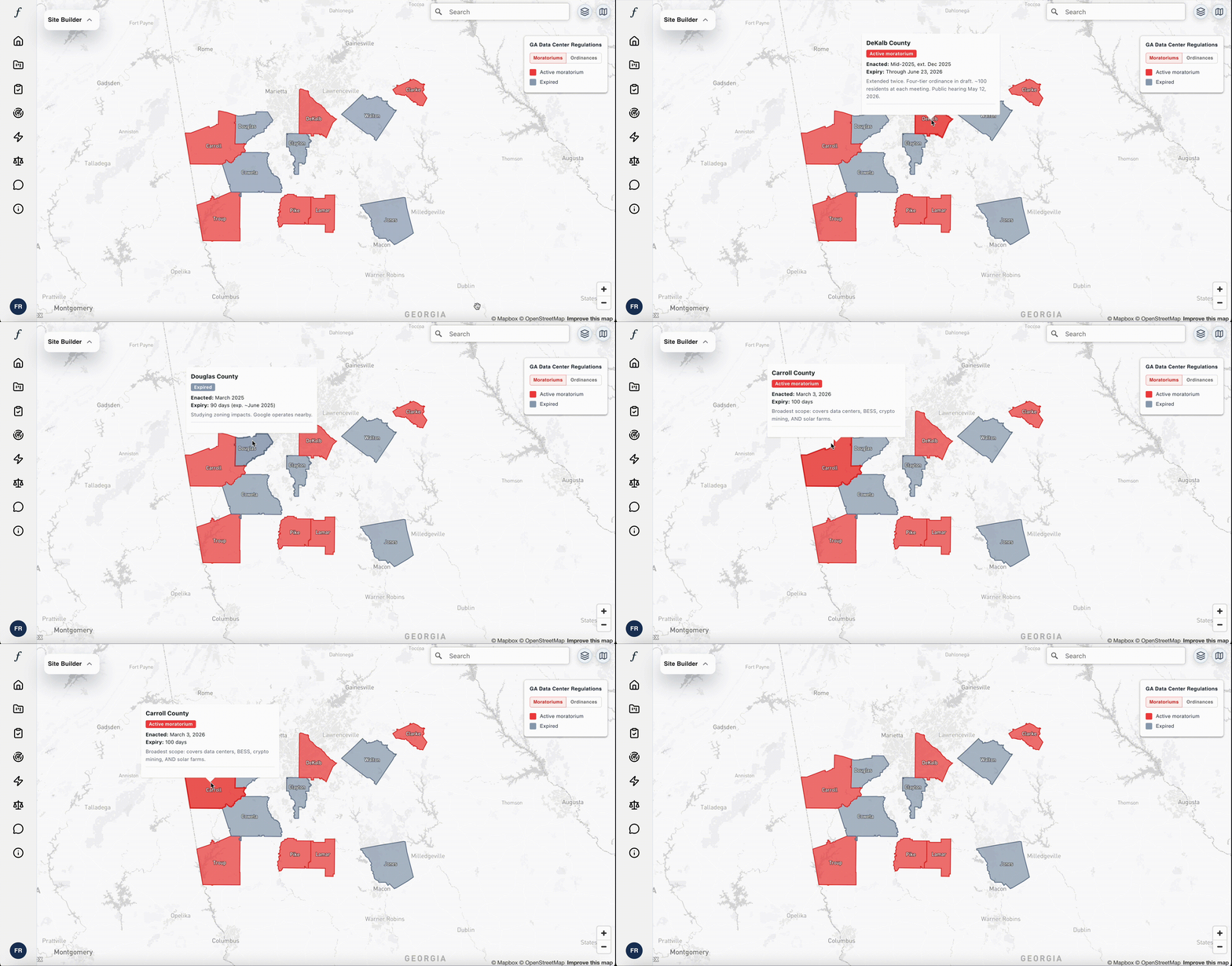
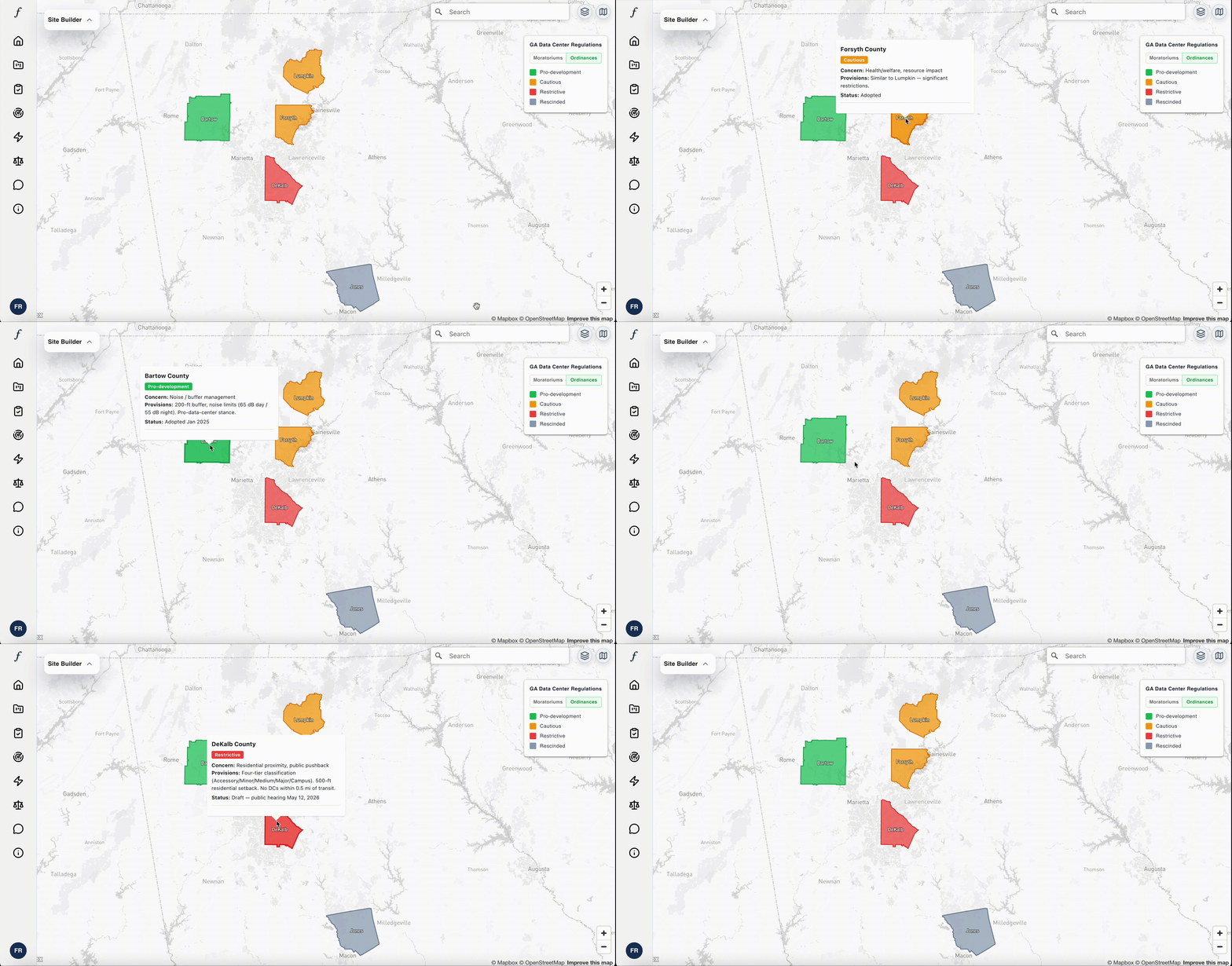
The following maps showcase where county moratoriums and ordinances are shaping the data center landscape in Georgia.
Moratoriums in key counties could lead to stronger regulations
New ordinances are changing construction and operational requirements for Data Centers
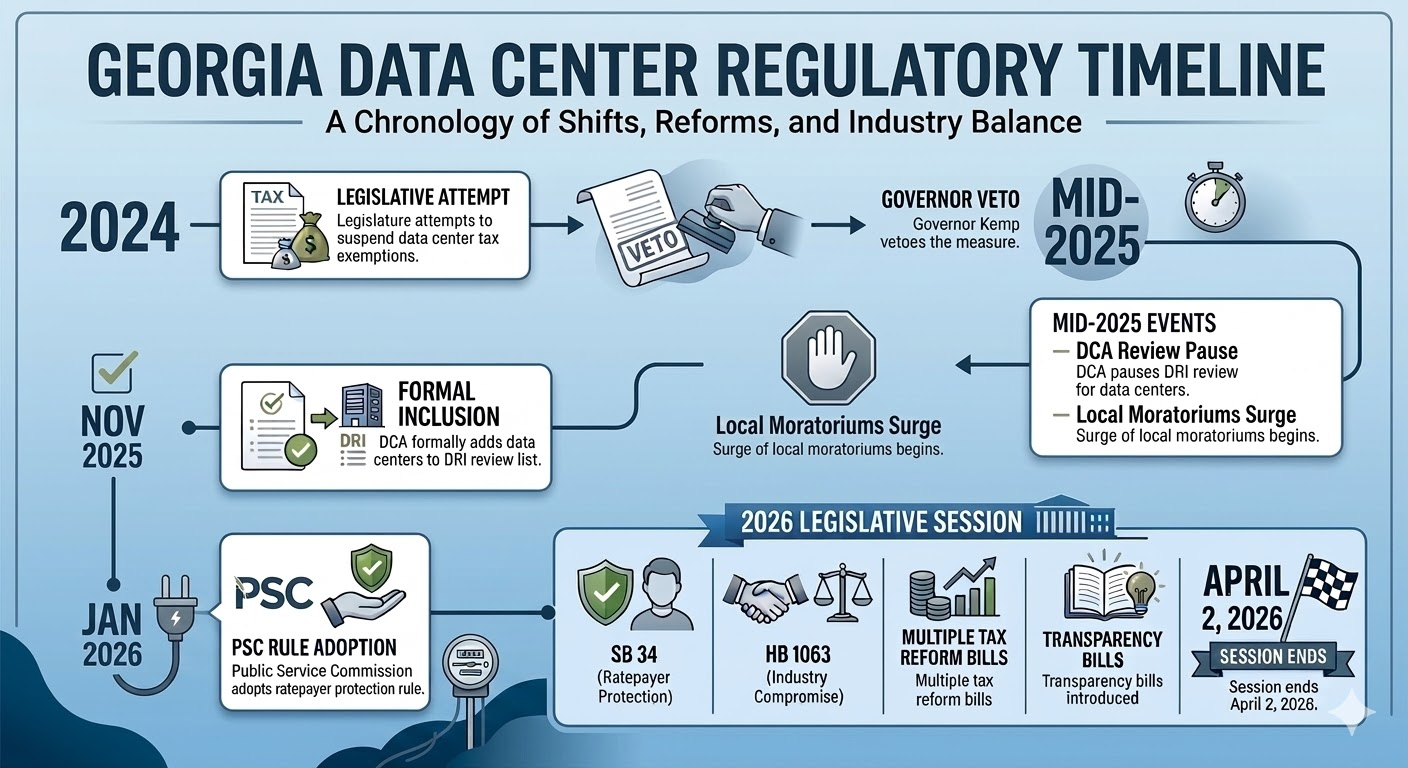
At the state level too, things are changing.
Both Republicans and Democrats have introduced legislation around data centers. While some are unlikely to pass and are more about political signaling, several, especially those introduced by Republicans, are more likely to pass given Republicans hold the majority in both chambers.
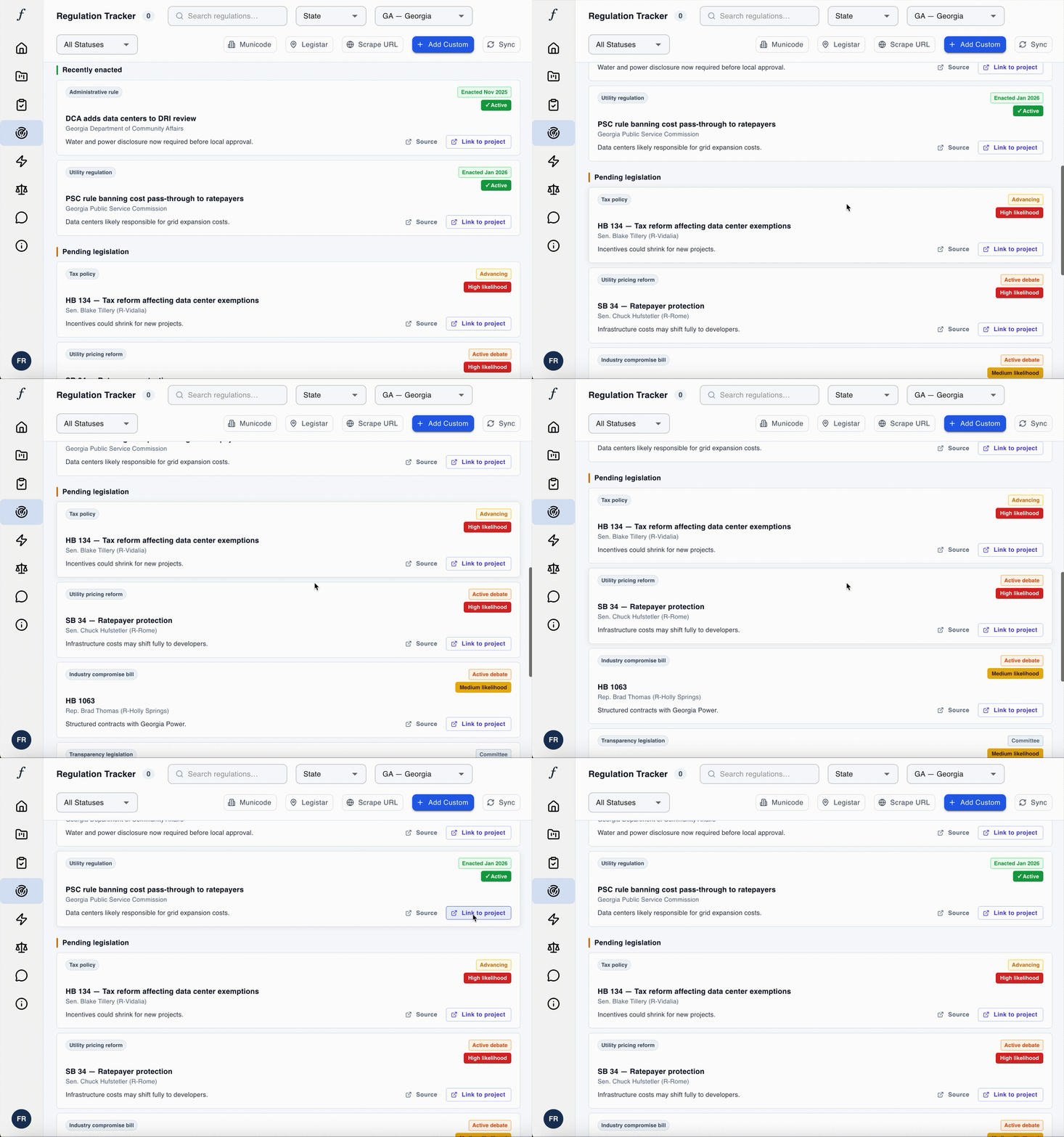
Here is a list of recent regulations, both passed and under consideration, related to data centers in Georgia:
Enacted / Active
| Category | Policy | Status | What it means for developers |
|---|---|---|---|
| Administrative rule | DCA adds data centers to Development of Regional Impact (DRI) review | Enacted Nov 2025 | Developers must disclose projected water and electricity demand before local governments can approve projects. |
| Utility regulation | PSC rule restricting cost pass-through for large-load customers | Enacted Jan 2026 | Utilities cannot shift new infrastructure costs from data centers to residential ratepayers, increasing the likelihood developers pay for grid upgrades. |
Proposed / Pending Legislation
| Category | Bill | Status | Probability | What it means for developers |
|---|---|---|---|---|
| Tax exemption reform | SB 410 (Sen. Matt Brass): Removes equipment sales tax exemption for new data centers, preserves existing ones | Passed Senate Mar 6 | High | New projects would lose Georgia's data center equipment tax exemption. |
| Tax policy | HB 134: broader tax reform eliminating ability to grant new data center exemptions | Passed Senate Feb 12 | High | Data center tax incentives could shrink as part of wider state tax reform. |
| Utility pricing reform | SB 34: ratepayer protection bill | Stalled Feb 26 | Medium | Would prohibit utilities from passing data center infrastructure costs to residential customers. |
| Industry compromise | HB 1063 (Rep. Brad Thomas) | Active debate | Medium | Requires longer power contracts and upfront payments from data centers to cover infrastructure. |
| Tax exemption suspension | SB 436 (Sen. Jaha Howard) | Committee | Medium | Temporarily suspends new exemption certificates (Jul 2026–Jun 2027) and bans NDAs with local governments on resource usage. |
| Transparency legislation | SB 421 (Sen. RaShaun Kemp) / HB 528 (Rep. Park Cannon) | Committee | Medium | Requires annual reporting of water, energy use, and community impact; bans NDAs with local governments. |
| Tax exemption sunset | SB 408 (Sen. Orrock) / HB 559 (Rep. Carson) / SB 476 (Sen. Tillery) | Committee | Medium | Various approaches to sunset or repeal the data center tax exemption (partially superseded by SB 410). |
| Consumer advocacy | SB 94: reestablishes consumer utility counsel in AG office | Passed committee | Medium | Adds formal ratepayer representation in PSC disputes involving large-load customers. |
| Statewide moratorium | HB 1012 (Rep. Romman) / HB 1059 (Rep. Jackson) | Committee | Low | Proposed statewide pause on new data center construction (HB 1059 includes impact commission through 2028). |
Conclusion
Given the rate of change, developers cannot make do with just lawyers and manual processes. They need a system that can:
- Generate a list of tasks to be done for existing rules and proposed changes
- Monitor local ordinance changes
- Track DRI triggers and submission requirements
- Surface power and water disclosure obligations
- Compare county requirements across jurisdictions
- Identify community sentiment issues before hearings
- Maintain an auditable record of what changed, where, and when
That is a software workflow problem. Today, much of this work is done manually across local agendas, ordinances, DRI filings, commission meetings, legislation, and community reporting. That makes it slow, fragmented, and easy to get wrong. The challenge is not just interpreting regulations. It is keeping up with a moving target across dozens of jurisdictions at once.
Flotive automates regulatory compliance so your team can focus on moving projects forward, not chasing changes.